
Chart your family's Nasab with honor and precision
Preserve your lineage (Ilm al-Ansab) with a family tree builder drawn in the shape of a classical nasab, father to son, with names in Arabic script, multiple wives, and cousin marriages.
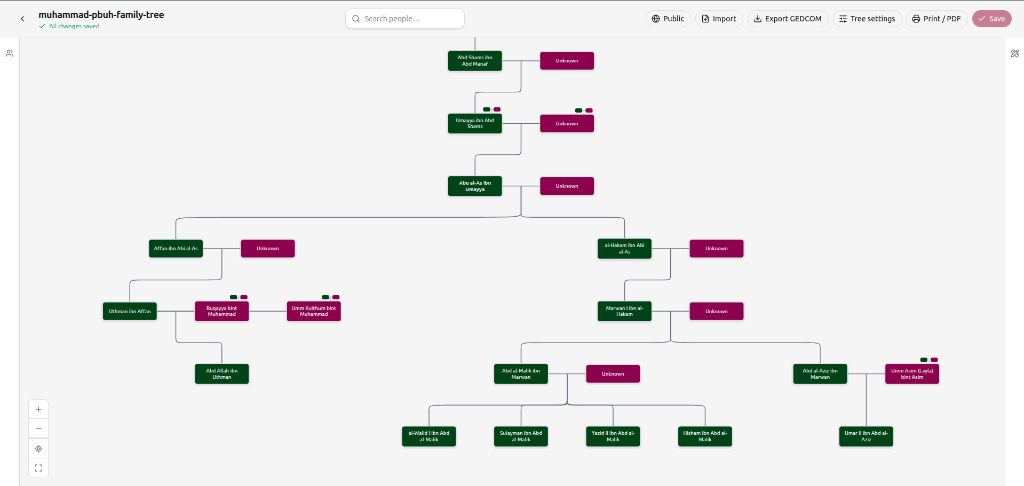
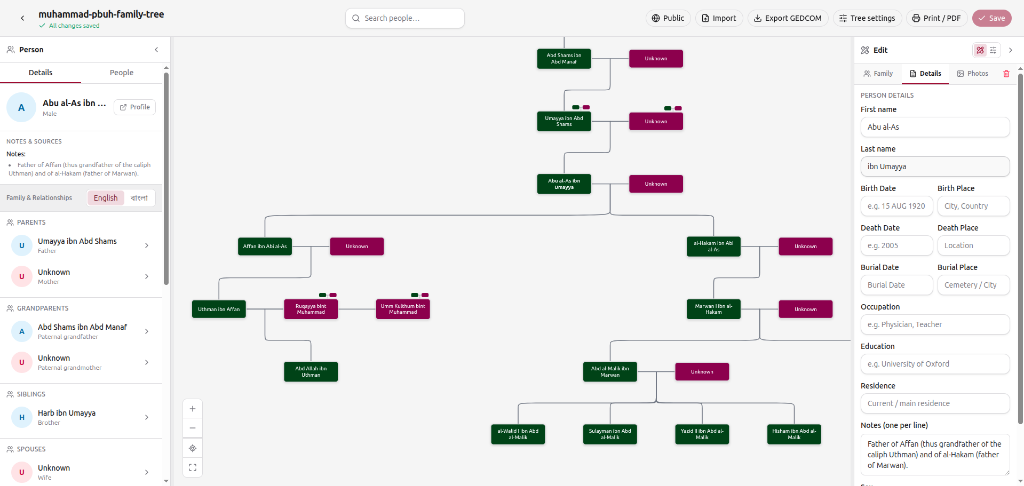
Lineage of Prophet Muhammad (PBUH)
Explore the family of the Prophet on Blaadline's public interactive chart. Click anyone to follow their line, or open their page.
Purpose-built for Islamic family genealogy
Arabic & Urdu Names
Enter names directly in Arabic, Urdu, Persian, or Bengali. Your browser shapes and draws the script itself, so any script your device can display appears on screen and in the printed PDF.
First-Cousin & Cross-Branch Marriages
Cousins who share a grandfather can be recorded as husband and wife. When a wife is herself a descendant of the line, she appears twice on the chart: as her father's daughter and as her husband's wife.
Traditional Nasab Naming
Names are free text, so a kunya (Abu/Umm), ism, nasab (ibn/bint), and nisba can be written exactly as your family records them.
Heirloom Shajara Prints
Export your family Shajara as a vector PDF, ready to print and frame as an Eid gift or pass down to your children.
Islamic Genealogy FAQs
- What is a Shajara or Nasab family tree in Islam?
- A Shajara (literally 'tree' in Arabic) or Shajara al-Nasab is a genealogy chart tracing the lineage and patrilineal heritage of a Muslim family. In Islamic tradition, preserving knowledge of one's lineage (Ilm al-Ansab) is encouraged to uphold kinship ties (Silat al-Rahim).
- Can I enter names in Arabic script?
- Yes. Names can be typed in Arabic, Urdu, Persian, Bengali, or any other script your device can display. They appear on screen and in the printed PDF, drawn with the fonts on your system.
- How does Blaadline handle cousin marriages (consanguinity)?
- In many Muslim families, marriages between first or second cousins are common, and Blaadline allows them. When the wife is herself a descendant of the line being drawn, she appears twice: once as her father's daughter and once beside her husband. Both cards are the same person, so an edit to one shows on both.
- Can I explore the Prophet Muhammad (PBUH) family tree on Blaadline?
- Yes. Blaadline publishes an official, interactive family tree of the Prophet Muhammad (PBUH), free to explore in the Explore gallery.
Uphold your kinship ties for the next generation
Build your family tree online, preserve Arabic names, and print a treasured Shajara for your home.
Start your family tree free